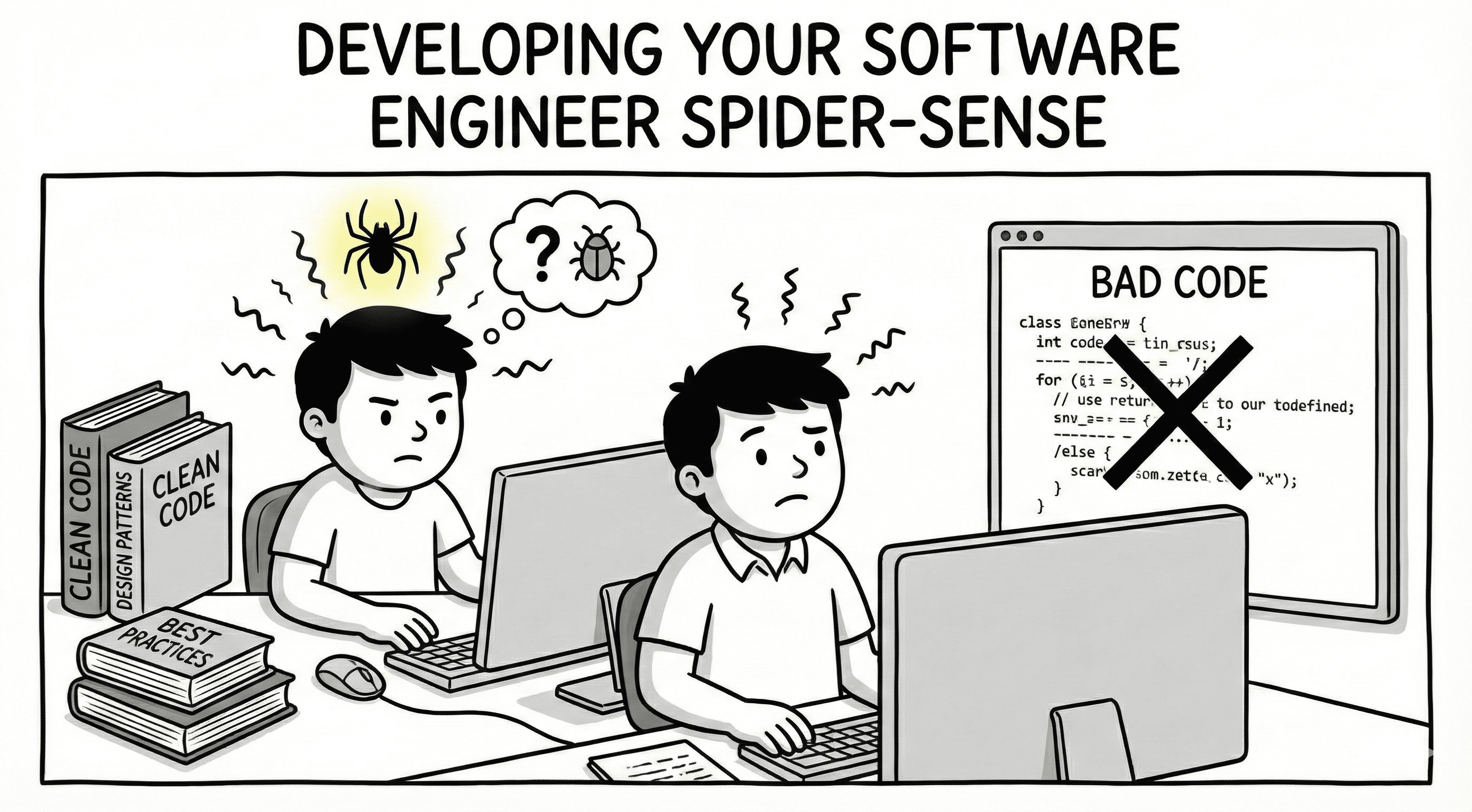
As an active university student who also active in Software Engineering career. I realized that there is something that always missig when i see my fellow friends learning how to code. That is the "Spider-Sense" to spot potential issues or bad practices in code.
Let's take this code example of connecting a Java program to database that our lecturer gave us:
import org.jspecify.annotations.Nullable;

import java.sql.Connection;
import java.sql.DriverManager;
import java.sql.SQLException;

public final class TodokuDatabase {
    private static final String DATABASE_URL = "jdbc:mysql://localhost:3306/todoku-db";
    private static final String USER = "root";
    private static final String PASSWORD = "example-root-pw";

    @Nullable
    public static Connection getConnection( ) throws SQLException {
        try {
            Class.forName("com.mysql.cj.jdbc.Driver");
            DriverManager.registerDriver(new com.mysql.cj.jdbc.Driver());

            return DriverManager.getConnection(DATABASE_URL, USER, PASSWORD);
        } catch (ClassNotFoundException e) {
            e.printStackTrace();
            System.err.println("JDBC Driver not found.");
        }
        return null;
    }
}
It seems fine and nothing wrong with it right? I mean how come our lecturer gave us a bad code example? Well, if you have that "Spider-Sense" you would immediately spot some potential issues with this code:
- There is no singleton pattern implemented for the database connection. Every time
getConnection()is called, a new connection is created which can lead to resource exhaustion. - There is no connection pooling mechanism. Creating and closing database connections is expensive in terms of performance.
- The database credentials are hardcoded in the class, which is a security risk. They should be externalized to a configuration file or environment variables.
But Terence, how can i notice this? I'm just a beginner, I don't have that "Spider-Sense" yet.
The key is to always question the code you see. Ask yourself:
- Is this code safe?
- Is this code efficient?
- Is this code maintainable?
- Can this code be readable by other people (even my future self)?
- Are there any best practices that are not being followed here?
By constantly asking these questions, you will start to develop that "Spider-Sense" for spotting potential issues in code.
Because at the end of the day, as a Software Engineer we always wanted to write code that is not only functional but also safe, efficient, and maintainable for further development plus safe and easy to read for another developer.
Anyway here's the improved version of the code above with connection pooling and externalized configuration:
package org.ilmi.database;

import org.jspecify.annotations.Nullable;

import java.sql.Connection;
import java.sql.DriverManager;
import java.sql.SQLException;

public final class TodokuDatabase {
    // Uses environment variables for configuration
    private static final String DATABASE_URL = getEnvOrThrow("TODOKU_DB_URL");
    private static final String USER = getEnvOrThrow("TODOKU_DB_USER");
    private static final String PASSWORD = getEnvOrThrow("TODOKU_DB_PASSWORD");

    // Singleton instance of the database connection
    private static Connection INSTANCE;

    private TodokuDatabase() {
        // Private constructor to prevent instantiation
    }

    public static Connection getInstance() throws SQLException {
        // Making sure we only have one connection instance (Singleton Pattern)
        if (INSTANCE == null || INSTANCE.isClosed()) {
            // Only create a new connection if there isn't one or if it's closed
            INSTANCE = getConnection();
        }
        return INSTANCE;
    }

    // Helper method to get environment variable or throw an exception if not set
    private static String getEnvOrThrow(String name) {
       String value = System.getenv(name);
        if (value == null) {
            throw new IllegalStateException("Environment variable not set: " + name);
        }
        return value;
    }

    // Method to create a new database connection
    @Nullable
    public static Connection getConnection() throws SQLException {
        try {
            Class.forName("com.mysql.cj.jdbc.Driver");
            DriverManager.registerDriver(new com.mysql.cj.jdbc.Driver());

            return DriverManager.getConnection(DATABASE_URL, USER, PASSWORD);
        } catch (ClassNotFoundException e) {
            e.printStackTrace();
            System.err.println("JDBC Driver not found.");
        }
        return null;
    }
}
'Wait a minute, where is the connection pooling mechanism? ' That's right because that's another topic that i will discuss in another blog post stay tune 😊.
'But Terence... How can i know all these best practices and all this patterns?' The answer is simple, keep learning and practicing. Read books, articles, and blog posts about software engineering best practices.
Quick tips to develop your "Spider-Sense":
- Make learning your daily habit. Every day i always make sure that i learn something new about software engineering.
- Be hungry for knowledge. Always seek to understand why certain practices are recommended.
- Start a project. The more you code, the more you will encounter different scenarios and challenges.
- Review other people's code. This will expose you to different coding styles and practices.
- Join developer communities. Engage in discussions and learn from experienced developers.
With time and experience, your "Spider-Sense" will become sharper, and you'll be able to spot potential issues and bad practices in code more easily, and of course become a Software Engineer like you dreamt of when you choose your degree in Computer Science.
Happy coding and keep that Spider-Sense tingling! 🕷️💻